

Prenuptial agreements, postnuptial agreements, and cohabitation agreements are all “Domestic Contracts” just like separation agreements, and all fall under the same sections of the legislation. These domestic contracts have moved well beyond the very wealthy. Canadians across different income levels are asking these questions before getting married, before moving in together, and sometimes years into a relationship when circumstances have changed.

Core emotional themes addressed by domestic contracts

Domestic agreements address a number of emotional realities: 

Fear of being taken advantage of

"What if they try to take everything in a divorce?", "I've been burned before”, "I'm bringing significantly more assets into this". These concerns are legitimate, and a well-drafted agreement is a direct response to them.

Worry that raising it will damage the relationship

"Will asking for a prenup offend them?”, “Does it mean I don't trust them?”, “Does it signal I expect this to fail?" This is one of the most common hesitations, and it deserves a direct answer: asking for financial clarity is not the same as anticipating divorce. Wills, life insurance, and power of attorney serve the same function: planning for the possibility of things going differently than hoped. Most couples who do this process thoughtfully report that it strengthens communication, not weakens it.

Confusion about who really needs one

"We're not rich -  do we need a prenup?" Many middle-class Canadians benefit materially from having an agreement in place, whether they have a home, a small business, significant savings, children from a prior relationship, or a significant income gap between partners.

Misunderstanding about common-law rights

"We've lived together five years — aren't we basically married?" The answer depends heavily on which province you live in, and in most of Canada, common-law couples do not automatically have the same property rights as married spouses. This is one of the most costly misconceptions in Canadian family law.

Definitions and basic concepts

Prenuptial Agreement

A prenuptial agreement, or "marriage contract" in some provinces, is a written legal contract signed before marriage that defines how the couple will handle property, debts, and spousal support if they separate or if one partner dies. It allows couples to modify or replace the default rules that family law would otherwise apply.

Postnuptial agreement

A postnuptial agreement serves the same purpose as a prenuptial agreement but is signed after the couple is already married. It is used when couples did not do a prenup before the wedding, or when circumstances have changed significantly, such as an inheritance, a business becoming successful, a career change, or a reconciliation after a period of separation that prompts both parties to revisit their arrangements.

Cohabitation agreement

A cohabitation agreement is a contract for unmarried partners who live together or plan to live together. It can cover property ownership and division, debt responsibility, spousal support, and what happens on separation or death. In many provinces, a cohabitation agreement automatically converts to a marriage contract if the couple later marries, unless the agreement specifies otherwise.

Why people use these agreements

Significant Pre-Existing Assets

One partner owns a home, a business, or substantial investments before the relationship. Under default family law, the increase in value of those assets during the marriage can be subject to equalization or division at separation. An agreement can keep those assets separate, or define a specific sharing formula that reflects both parties' contributions and expectations. This is not just for the very wealthy, but also valuable for someone who owns a small business, a rental property, or a family cottage.

Children from Previous Relationships

Blended families have estate and property planning concerns that need to be addressed in writing. A parent may want to ensure that specific assets flow to children from a prior relationship rather than to a new spouse. A prenup or marriage contract is the appropriate instrument to document these intentions and give them legal weight.

Large Income or Wealth Disparity

When one partner earns significantly more, or brings substantially more wealth into the relationship, then both parties benefit from clear expectations. The higher earner may want defined and limited spousal support obligations; the lower earner may want a guaranteed minimum support arrangement that removes uncertainty. A well-drafted agreement serves both needs.

Resolving Conflicts in Married Couples

Postnuptial agreements can be used to resolve conflicts that could otherwise cause a couple to separate. Often a structured negotiation process guided by a mediator can assist a married couple to come to an agreement they would not be able to achieve by themselves.

Family or Business Pressure

It is common for family businesses to require a marriage contract as a condition of transfer, particularly those being transferred between generations. Parents who intend to gift or transfer significant assets often require this as well. In these cases, the agreement protects not just the couple but the family's legacy assets from an unknown future.

Common-Law Partners Without Automatic Property Rights

In most provinces, common-law partners do not automatically share property regardless of how long they have lived together. If the couple buys a home and only one name is on title, the other has no legal claim to it without an agreement or a successful constructive trust claim through the courts, which is expensive, uncertain, and emotionally draining. A cohabitation agreement prevents this entirely by defining ownership and entitlements from the start.
Source: Toronto Family Lawyer — Differences between Cohabitation Agreements and Marriage Agreements Under Canadian Law

What can and cannot be included

What CAN Be Included

Domestic contracts can cover a wide range of financial arrangements:

  • Property and asset division: who keeps the family home, how other real property (investment homes, cottages, land) is divided, allocation of bank accounts, investments, pensions, and business interests.
  • Pre-relationship assets: confirming that assets owned before the relationship remain separate and are not subject to equalization or division.
  • Debt responsibility: who is responsible for pre-existing debts (student loans, credit cards, business debts) and how debts incurred during the relationship are handled on separation.
  • Inheritances and gifts: specifying that inheritances or gifts received by one partner during the relationship remain that person's separate property and are excluded from division.
  • Spousal support: defining whether spousal support is payable, setting amounts, durations, formulas, or conditions; or waiving spousal support entirely (subject to the limitations discussed below).
  • Rights to the family home: defining buyout terms, right to remain in the home after separation, how proceeds are divided if sold
  • Future income and growth: defining how income growth, dividends, or investment returns on pre-existing assets are treated.
  • Life insurance, review schedules, and dispute resolution: many agreements include provisions requiring each party to maintain life insurance, a schedule for reviewing the agreement every five years, and a requirement to attempt mediation before litigation.

What CANNOT Be Included

Child support cannot be predetermined or waived. Child support is the child's right, not the parents' right, and courts will override any provision that attempts to waive or limit it below the Child Support Guidelines. Couples can document their understanding of how support would be calculated under the Guidelines, but a court will recalculate based on actual circumstances at the time of separation.

Child custody and parenting arrangements cannot be locked in. Courts decide parenting based on the child's best interests at the time of separation, which may be many years after the agreement was signed. Circumstances and children's needs change. While parties can express their preferences or intentions, a judge is not bound by these provisions.

Clauses contrary to public policy will not be enforced. This includes: 

  • Blatantly one-sided terms; 
  • lifestyle controls that restrict a partner's personal freedom (forbidding work, requiring certain behaviours, dictating social relationships); 
  • and any provision that purports to waive a party's right to obtain independent legal advice.

Important note on spousal support waivers: while parties can include a complete waiver of spousal support, courts retain the authority to override this waiver if enforcing it would produce an unconscionable result. This can happen when circumstances have changed significantly since signing. A waiver signed in a different financial and personal reality may not hold decades later.

Source: Devry Law — What Marriage Contracts or Cohabitation Agreements Cannot Do

Enforceability: The Miglin Test

The Framework

Canadian courts apply a two-stage analytical framework to decide whether to uphold or override a domestic contract, established by the Supreme Court of Canada in Miglin v. Miglin (2003). This framework applies across the country and provides both couples and lawyers with a clear standard for drafting enforceable agreements.

The Miglin test includes 2 stages described below:

Provincial differences and terminology

Ontario

Ontario uses the terms "marriage contract" (for married couples) and "cohabitation agreement" (for common-law couples) under the Family Law Act. One important Ontario-specific rule applies to the matrimonial home: normally, the value of an asset owned before marriage can be deducted from one's net family property for equalization purposes. The matrimonial home is an exception. Its full value at the date of separation is shared between spouses, even if one partner owned it before the marriage. A marriage contract can modify this to some extent, but cannot eliminate rights to the matrimonial home entirely.

Common-law couples in Ontario have no automatic property division rights. A cohabitation agreement is the only mechanism available to define property ownership and entitlements without going to court.

British Columbia

BC's Family Law Act treats married and qualifying common-law spouses similarly for property division purposes. A common-law "spouse" in BC is a person who has cohabited with another for at least two years, or less if they have a child together. Both married and qualifying common-law spouses share in "family property" equally on separation. Agreements can be used to contract out of this default equal division and customize arrangements to suit the couple's situation.

Alberta

Alberta recognizes "Adult Interdependent Partners" (AIPs): couples who have lived together for three or more years, or for any period if they have a child together and are in a "relationship of interdependence." Since January 2020, AIPs have the same property rights as married spouses under the Family Property Act. Agreements (cohabitation agreements or AIP agreements) can modify these default arrangements.

Quebec

Quebec operates under civil law, and marriage contracts (contrats de mariage) must be notarized to be legally binding. The default matrimonial regime is partnership of acquests: assets owned before marriage remain separate, while assets acquired during the marriage are generally shared equally on dissolution. Couples can choose alternative regimes (separation of property or community of property) through a notarized marriage contract.

Critically, Quebec de facto (common-law) couples have historically had no automatic property or spousal support rights. Despite some recent legislative changes for certain couples with children, a cohabitation agreement remains essential for common-law couples in Quebec. Without one, separation can mean the non-titled partner loses all claim to property they helped build.

Other Provinces and Territories

Most other provinces follow a framework broadly similar to Ontario in structure, with their own family property legislation and varying thresholds for common-law recognition. Each province has its own rules around terminology, witnessing requirements, and what constitutes a qualifying common-law relationship. A family lawyer in your province is the most reliable source for jurisdiction-specific advice.

Source: Crossroads Law — Everything You Need to Know About Adult Interdependent Partnerships in Alberta

Source: Quebec.ca — Marriage Contract

Source: Get Jointly — Are Prenuptial Agreements Enforceable in Canada?

How much do domestic agreements cost?

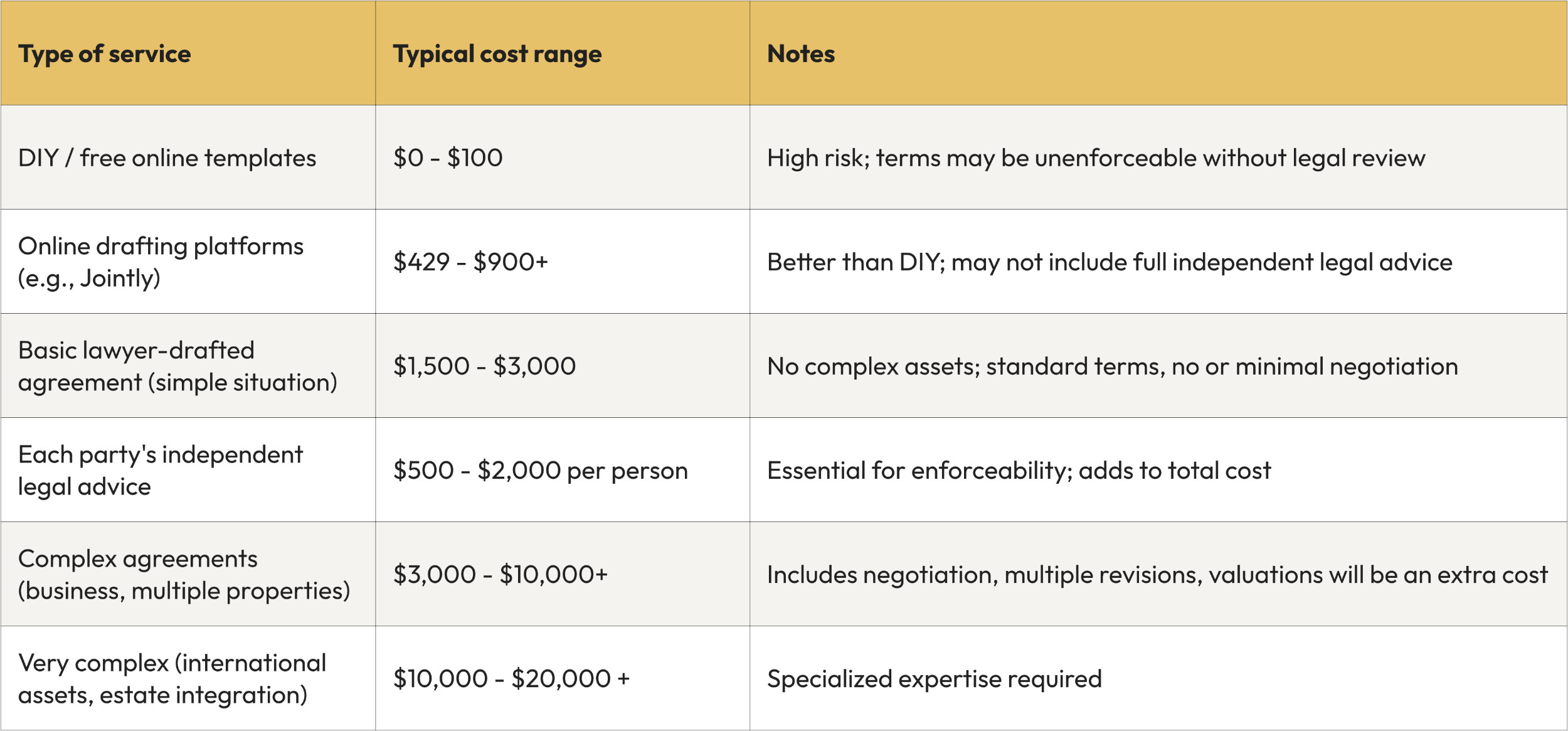
A basic lawyer-drafted agreement typically costs $1,500–$3,000 per couple, plus $500–$2,000 per person for independent legal advice. Complex agreements involving businesses or multiple properties run $3,000–$10,000 or more. 

Below is an overview of typical cost ranges:

A table comparing the different options for attaining a domestic agreement and the typical cost ranges and things to watch out for.

Hourly rates for family lawyers in major Canadian urban centres typically range from $250 to $600 per hour. Business valuations, if needed, add $1,000 to $5,000 or more. Real estate appraisals typically run $300 to $600 each.

The cost-benefit calculation is relatively straightforward: a properly drafted agreement costing $2,000 to $5,000 can prevent a contested divorce costing $20,000 to $100,000 or more in legal fees, while also preserving the couple's relationship with each other and their families

Practical steps to getting a strong agreement

1

Start with an honest conversation

Before lawyers are involved, talk through what you each want to protect, what feels fair, and what the agreement should cover: property, debts, spousal support, the matrimonial home, inheritances, business interests, life insurance, and a review schedule. This conversation reduces legal costs and the risk of conflict later.


2

Gather full financial disclosure

Each party compiles a complete picture: last two years' tax returns, pay stubs, a full list of all assets with current values (real property, investments, vehicles, business interests, pensions, savings), and a complete list of all debts. This information is exchanged and reviewed by both parties before drafting begins.


3

Meet with a family law professional early

Get advice on what is realistic and legally permissible in your province before any draft is written. A mediator can also help facilitate the initial conversation if you want a structured, lower-cost way to align on terms before engaging lawyers.


4

Draft, then allow genuine negotiation

A lawyer drafts the initial agreement based on your instructions and the disclosed financial picture. Both parties and their respective lawyers review it, raise concerns, and propose revisions. If both parties engage to resolve the disagreements, then that indicates a genuine negotiation process. If one party refuses to engage with any revisions, that is a warning sign for future enforceability.


5

Each get independent legal advice, confirmed in writing

Before signing, each party meets separately with their own lawyer to review the final version. The lawyer confirms in writing that their client understands the agreement, its implications, and signed voluntarily. This written confirmation is one of the most important pieces of evidence if the agreement is ever challenged.


6

Sign prenups well before the wedding

Aim for weeks or months before, not days. Signing in a calm, low-pressure period, separate from the intensity of wedding planning, is itself evidence against duress. Last-minute signing is one of the most common grounds for setting an agreement aside.


7

Store safely and review periodically

Each party keeps a signed original; the drafting lawyer retains a copy. Revisit the agreement every five years or after any significant life event such as the birth of a child, substantial inheritance, major business change, serious illness, or a significant shift in either party's income.


The emotional side: Raising the conversation

The most common reason people delay or avoid these conversations is not cost or complexity, but the fear that raising the topic will damage the relationship. That concern is understandable and worth taking seriously.

Timing and framing matter enormously. The wrong approach would be to present a drafted agreement days before the wedding, as a surprise and under time pressure. The right approach is to raise the topic months before the wedding, framing it as a mutual planning conversation rather than a demand, and being genuinely open to both partners' concerns and priorities being reflected in the final document.

Language matters too. "I want us both to be protected and clear about what we're each bringing into this" lands differently than "My lawyer told me I have to do this." Framing it as something both partners participate in rather than something one partner imposes on the other is the difference between a process that strengthens a relationship and one that is damaging. 

A mediator or collaborative family law professional can facilitate these conversations in a neutral, structured way if the direct conversation feels too charged. This can actually be an efficient approach: a neutral professional helps both parties identify what matters to them, which reduces the number of drafting iterations and legal costs later.

If you feel pressured to sign a domestic agreement, then that’s a major red flag. Do not sign if you are being asked to sign an agreement under time pressure, without time to consult a lawyer, or with implicit or explicit threats. An agreement signed under duress is vulnerable to being set aside. You are entitled to say "I need time to consult a lawyer". and that right cannot be signed away.

Common myths

Myth: Prenups are only for the rich.

Reality: Anyone with a home, a business, significant savings, children from a prior relationship, or a meaningful income gap can benefit. The cost of a proper agreement ($2,000–$5,000) is often a fraction of what a contested divorce costs without one.

Myth: If we love and trust each other, we don't need anything in writing.

Reality: Love does not prevent job loss, illness, or relationship breakdown — all of which change financial circumstances dramatically. Agreements protect both partners when emotions are at their most difficult. The same logic applies to wills and life insurance.

Myth: Courts never enforce prenups in Canada.

Reality: Courts routinely enforce properly drafted agreements. Full disclosure, independent legal advice, voluntary consent, and fair terms produce highly reliable, enforceable contracts. Courts only override in limited circumstances involving duress, non-disclosure, or unconscionable results.

Myth: If I sign a prenup, I'll end up with nothing.

Reality: A well-negotiated agreement protects both parties. Courts will not enforce unconscionably one-sided terms. The Miglin test exists specifically to protect the less powerful party from exploitation.

Myth: Common-law means I automatically have the same rights as a married spouse after a few years.

Reality: This varies significantly by province. In Ontario and Quebec common-law partners have no automatic property division rights regardless of how long they have cohabited. There are automatic rights for common-law partners in BC (after 2+ years) and Alberta (3+ years), but the specific rules vary. Never assume; always check your province's rules with a family lawyer.

Source: OW Lawyers — 5 Common Myths About Pre-Marital Agreements Debunked

A note on how these agreements connect to separation and divorce

A prenuptial, postnuptial, or cohabitation agreement is a planning tool, not a guarantee of an easy separation. When the time comes, the agreement becomes the starting point for property division and support discussions, but the terms still need to be implemented and in some cases, debated.

Having a well-drafted agreement in place before a separation typically means a shorter, less expensive, and less emotionally charged process when separation does occur. Both parties know what to expect, which reduces the space for dispute. It does not eliminate the need for legal advice at separation, but it changes the nature of that advice from "let's figure out what you're entitled to" to "let's implement what you already agreed."

If you are considering a prenuptial, postnuptial, or cohabitation agreement and would like to understand how it fits into a broader separation or divorce process, a free introductory meeting is available to discuss your specific situation.

Frequently asked questions

At Fairway, we understand that facing a divorce is daunting, bringing mixed emotions and many questions. We are committed to ensuring that you have the knowledge and tools to move through the process in a way that protects your assets and your children.

A prenuptial agreement (called a "marriage contract" in Ontario) is a written legal contract signed before marriage that defines how property, debts, and spousal support will be handled on separation or death. It lets couples customize arrangements rather than accepting default family law rules.

Yes, when properly signed. Courts apply the Miglin test: Stage 1 asks whether the agreement was fairly negotiated (full disclosure, independent legal advice, no duress, reasonable terms); Stage 2 asks whether it still makes sense at separation. Agreements meeting these standards are routinely enforced exactly as written.

Yes. A postnuptial agreement serves the same purpose as a prenup and is subject to the same enforceability requirements. It's commonly used when couples didn't sign a prenup, or when significant circumstances have changed, such as an inheritance, a business becoming more valuable, a career change, or reconciliation after a separation.

A cohabitation agreement is a contract for unmarried (common-law) couples that defines property ownership, debt responsibility, and spousal support expectations. It is particularly critical in provinces like Ontario and Quebec where common-law partners have no automatic property rights. Without a cohabitation agreement, only the titled owner has a legal claim to property.

Yes, to a significant degree. Agreements can keep pre-relationship assets separate, define buyout terms for a shared home, protect business interests from division, and shield anticipated inheritances. The matrimonial home has special protections in Ontario that cannot be entirely contracted away, but other terms around it can be customized.

No. Child support cannot be predetermined or waived. It is the child's right and courts will override any such provision. Parenting arrangements also cannot be locked in; courts decide based on the child's best interests at the time of separation, which may look very different from when the agreement was signed.

A basic lawyer-drafted agreement with no or minimal negotiation typically costs $1,500–$3,000 per couple, plus $500–$2,000 per person for independent legal advice. Complex agreements involving businesses or multiple properties run $3,000–$10,000 or more. This compares favourably to a contested divorce, which commonly costs $20,000–$100,000 in legal fees.

In that case default family law applies, which varies by province and relationship type. Married couples in most provinces divide property accumulated during the marriage through equalization or equal division rules. Common-law couples in most provinces have no automatic property rights; only the titled owner owns the property, unless the other party can prove a constructive trust through the courts, which is expensive and uncertain.